Supply Chain Shifts, OPEC+ Moves, and the UAE’s Energy Strategy
Published in Abu Dhabi, 02 Feb 2026 11:59 am (GST)
At the start of February 2026, the global oil market stands at a crossroads. Crude prices are caught between two opposing forces. On one side, a growing supply surplus is exerting downward pressure. On the other, geopolitical tensions continue to inject volatility into pricing. Brent crude has recently approached the $70 per barrel level amid renewed U.S.–Iran friction, even as consensus forecasts point to average pricing in the low $60s for the year ahead.
This complex environment is being shaped by three converging dynamics: structural shifts in global supply chains, recalibrated strategy within OPEC+, and long-term energy transition planning led by major producers such as the UAE.
Global Oil Supply Chain Shifts
The global oil supply chain has been materially reshaped by geopolitics, sanctions, and changing demand centres.
Following Russia’s invasion of Ukraine, crude trade flows were rapidly reoriented. By 2024, approximately 81 percent of Russian crude exports were flowing into Asia, primarily China and India, compared with around 40 percent in 2021. Europe’s share fell to roughly 12 percent, down from nearly half prior to the conflict.
European refiners responded by diversifying supply, increasing imports from the Middle East, Africa, and the Americas. This diversification improved resilience but raised transport costs and extended supply routes.
Key global shifts include:
- China, now the world’s largest crude importer, imported approximately 11.1 million barrels per day in 2024. Russia has become its largest single supplier, supported by discounted pricing and long-term bilateral trade arrangements.
- India dramatically expanded imports of Russian crude, which now account for roughly one-third of its total oil intake. This shift strengthened India’s refining margins but triggered political pressure from Western governments throughout 2025.
- Europe, following its embargo on Russian oil, sources roughly one quarter of crude imports from Africa and over one fifth from the United States. Middle Eastern producers, including the UAE, have also increased volumes into European markets.
- The United States remains a substantial crude importer at approximately 6.6 million barrels per day, despite its position as a top global producer. The U.S. primarily imports heavy crude grades from Canada to meet refinery specifications, while exporting lighter grades and refined products.
Beyond trade redirection, the supply landscape itself is expanding. New non-OPEC producers are gaining influence. Brazil, Guyana, and Canada are collectively expected to add around 2.4 million barrels per day of supply by 2026, intensifying competition and reinforcing a well-supplied global market.
At the same time, oil demand growth continues to tilt eastward. Consumption in Europe and Japan remains subdued due to efficiency gains and slower growth, while China and India continue to drive incremental demand. This reinforces Asia’s central role in global oil flows and strategic planning.
OPEC+ Dynamics in Early 2026
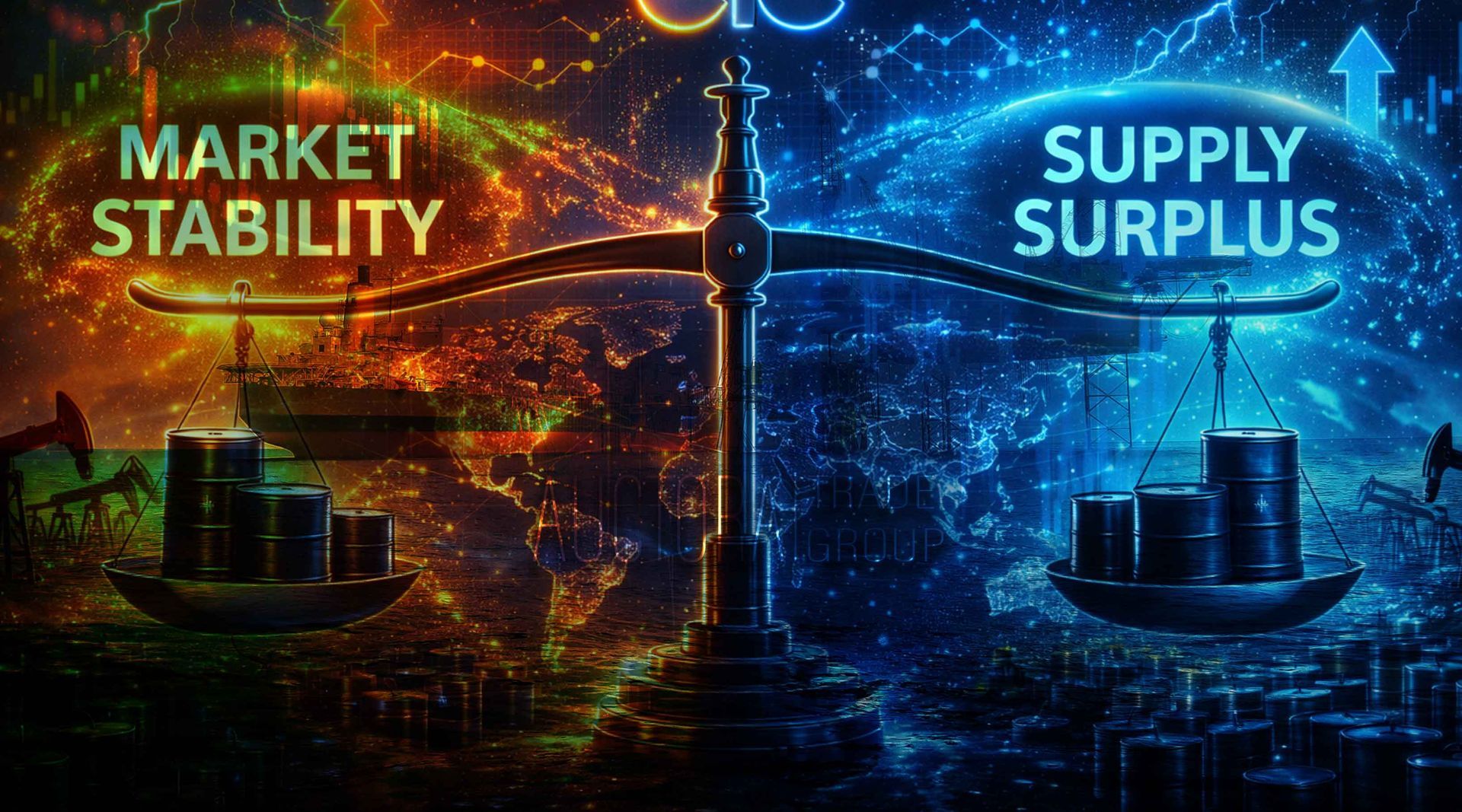
OPEC+ enters 2026 navigating a delicate balance between market stability and market share.
During 2025, the group pursued a strategy aimed at strengthening its position in Asian markets. Production targets were increased by approximately 2.7 to 2.9 million barrels per day between April and December, with India and China as primary destinations. While not all volumes materialised due to capacity and compliance constraints, the intent was clear.
As 2026 began, sentiment shifted. Global inventories rose and forecasts increasingly pointed toward a supply surplus. OPEC’s own projections moved from an anticipated deficit to a modest surplus for the year. Independent analysts have warned that excess supply could range from 0.75 to more than 3 million barrels per day.
In response, OPEC+ paused further production increases for the first quarter of 2026. Output levels were held steady through January, February, and March, with ministers citing seasonally weaker demand and the need to avoid flooding the market.
Despite this restraint, prices have remained supported by geopolitical risk. Late January saw Brent crude reach six-month highs amid concerns over potential escalation involving Iran. Expanded sanctions on Russia and intermittent supply disruptions in Kazakhstan further contributed to price support.
OPEC+ now operates within a narrow corridor. The group is signalling a willingness to defend a price floor through restraint, while remaining cautious not to surrender hard-won market share. Compliance remains a priority, particularly as divergent national interests place pressure on internal cohesion.
The UAE has played a distinct role within this dynamic.
Energy Transition and the UAE’s Strategy
Even as short-term market manoeuvres continue to play out, oil-producing nations are increasingly focused on long-term positioning. Energy transition strategies have become central to global energy planning, particularly among Gulf producers such as the United Arab Emirates. The UAE’s position is deliberately dual in nature. It is investing heavily to expand oil production capacity while simultaneously advancing clean energy and climate initiatives. Managing this balance is critical if the UAE is to retain its status as a global energy leader in a changing market.
On the hydrocarbons side, the UAE, through Abu Dhabi National Oil Company (ADNOC), continues to scale production.
As of 2025, ADNOC had raised sustainable capacity to approximately 4.85 million barrels per day, with a stated target of 5 million barrels per day by 2027. This expansion is supported by new upstream investments, enhanced recovery techniques, and partnerships with international operators. The strategy is straightforward. As a low-cost producer, the UAE aims to monetise its reserves efficiently while global oil demand remains structurally resilient. By increasing capacity, the country strengthens its ability to capture market share, particularly in Asia, and remain competitive even if demand growth slows.
This approach has been visible in recent OPEC+ discussions, where the UAE has consistently advocated for higher production ceilings based on efficiency, reliability, and economic opportunity. At price levels in the $60 to $70 per barrel range, the UAE remains highly profitable. Strategically, the country is positioning itself as a producer capable of sustaining output and relevance even as higher-cost producers face pressure. In effect, the UAE is preparing to remain competitive deep into the energy transition, including scenarios where global demand eventually plateaus.
At the same time, the UAE has taken a leading role in energy transition initiatives among oil-exporting states. It was the first country in the Middle East to commit to a net zero emissions target by 2050. This commitment is supported by large-scale investment in renewable energy, alternative fuels, and emissions reduction technologies. ADNOC established a dedicated low-carbon and international growth platform focused on renewable power, green and blue hydrogen, and carbon capture and storage. Significant capital continues to flow into solar and wind projects, both domestically and internationally through Masdar, alongside investment in one of the world’s largest green hydrogen developments.
The strategic objective is to diversify the national energy mix so that by 2030 a substantial share of domestic power generation comes from clean sources. This reduces internal oil consumption and preserves export capacity in the near term. Over the longer horizon, it positions the UAE as a supplier of alternative energy solutions, including hydrogen, to industrial markets in Asia and Europe seeking to decarbonise.
This dual-track strategy was clearly demonstrated when the UAE hosted the COP28 climate summit while remaining one of OPEC’s leading producers. The position articulated by Emirati leadership is that investment in oil and gas can coexist with climate action during the transition period.
The UAE frequently highlights the relatively low carbon intensity of its barrels and ongoing efforts to power oil operations using solar and nuclear energy to reduce upstream emissions.
In parallel, the country is pursuing downstream diversification. Expansion of petrochemical capacity through initiatives such as TA’ZIZ allows greater value extraction per barrel while reducing reliance on crude exports alone. Programmes like Make it in the Emirates further support domestic manufacturing, including energy-related equipment, strengthening industrial resilience and shortening supply chains.
Across the wider Gulf region, similar strategies are emerging. Saudi Arabia continues to expand production capacity while investing heavily in renewables and large-scale transformation projects under Vision 2030. Qatar is accelerating LNG expansion, positioning natural gas as a long-term transition fuel.
These producers recognise that while oil demand growth may slow over the next decade, hydrocarbons will remain integral to global energy systems for many years. Capturing market share now provides the capital base required for diversification.
The UAE’s approach exemplifies this balance.
It seeks to remain a core global energy supplier across oil, gas, and eventually hydrogen, while simultaneously preparing its economy for a post-oil future. As of early 2026, this strategy has given the UAE a strong and credible voice in both OPEC deliberations and international climate discussions, placing it in a distinctive position as both a leading producer and a forward-looking energy strategist.