How a rapidly expanding energy storage industry is reshaping critical mineral demand, international supply chains and investment — and why Abu Dhabi could become an increasingly important centre for the next generation of energy infrastructure.
17 November 2026 | Auctora Trade Group | Global Market Intelligence
The next major transformation in global energy may not be defined by how much electricity the world can generate.
It may be defined by how much electricity the world can store, control and deliver when it is needed most.
For decades, energy security has been associated with oil reserves, natural gas supplies, power stations and transmission infrastructure. Those fundamentals remain important, but another industry is now developing at remarkable speed.
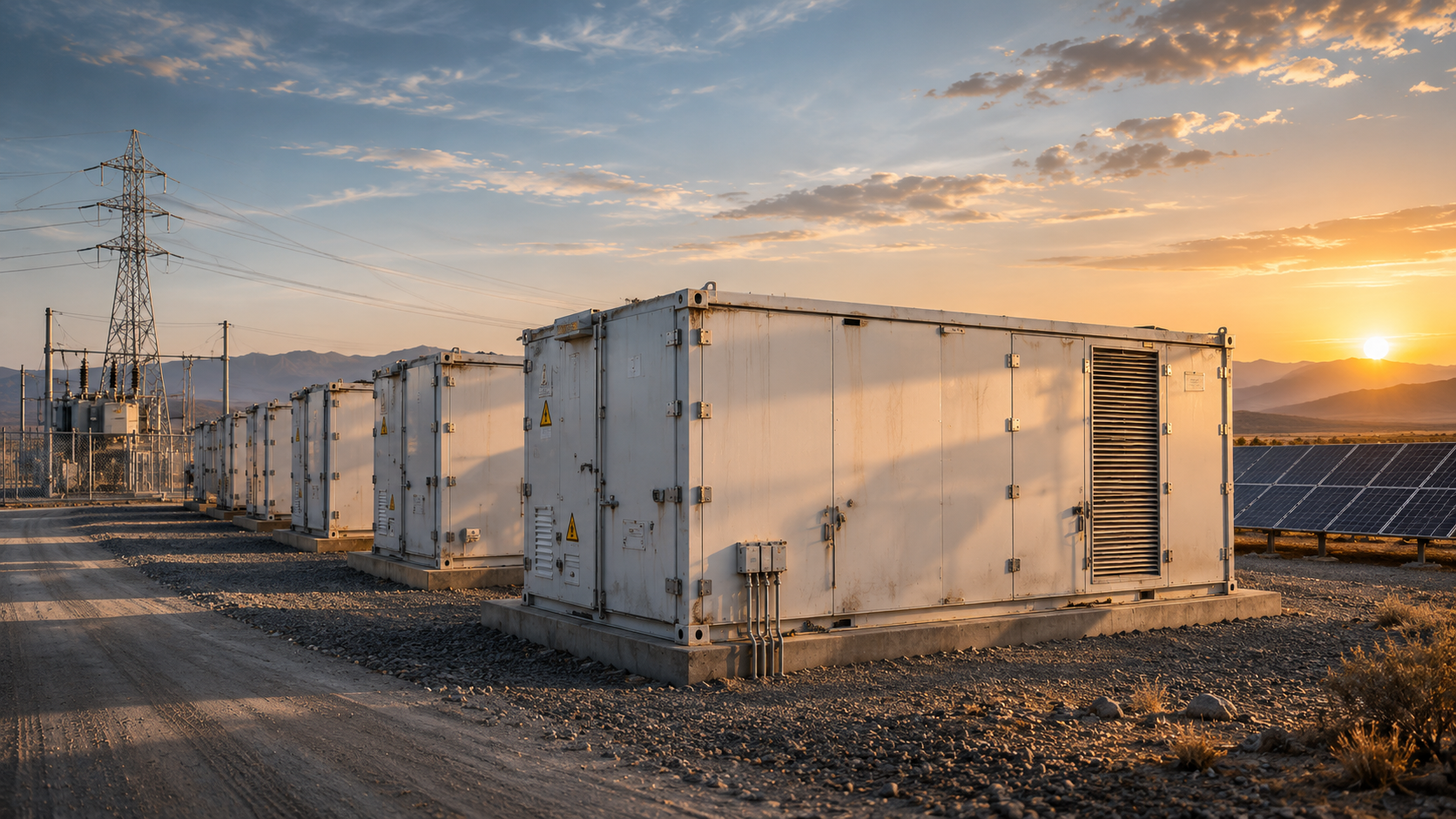
Battery Energy Storage Systems (BESS) are moving from a supporting technology to an increasingly important component of national energy infrastructure.
What was once largely viewed as a solution for intermittent renewable energy is becoming a strategic consideration for governments, utilities, industrial operators, technology companies and international investors.
And the scale of the market is beginning to change the economics of global trade.
For companies operating across energy, industrial commodities, critical minerals, manufacturing and logistics, this is a development that deserves considerably more attention.
At Auctora Trade Group, we believe the most interesting opportunities may extend well beyond battery manufacturing itself.
They sit within the increasingly complex international supply chains required to support the industry's expansion.
A global industry entering a new phase
Recent analysis published by Forbes highlighted the accelerating growth of energy storage, particularly across the United States.
The figures demonstrate how quickly the industry is developing.
According to the International Energy Agency (IEA), approximately 108 gigawatts of new battery storage power capacity were installed globally in 2025, an increase of 40% over the previous year.
Global installed battery storage capacity is now approximately eleven times higher than in 2021.
But developments in 2026 suggest that the industry is still expanding.
On 17 November, the Solar Energy Industries Association (SEIA), alongside Benchmark Mineral Intelligence, reported that the United States had installed 48.3 gigawatt-hours of battery energy storage during the first nine months of 2026, representing 20% growth year on year.
The country has now surpassed 200 GWh in cumulative installed energy storage capacity.
Meanwhile, BloombergNEF forecasts that global energy storage additions could reach approximately 188 GW of power capacity and 535 GWh of energy capacity in 2026, with further expansion expected in 2027.
These figures measure different aspects of storage capacity: gigawatts describe the rate at which electricity can be delivered, while gigawatt-hours describe how much energy can be stored.
Taken together, they point towards an industry moving into a much larger commercial and industrial phase.
This is no longer simply a story about renewable energy adoption.
It is becoming a story about infrastructure, capital allocation, manufacturing capacity and international trade.
The investment figures are becoming difficult to ignore
The expansion of battery storage is attracting substantial institutional investment.
According to the IEA's 2026 energy investment analysis, global battery energy storage investment reached approximately $78 billion in 2025 and is expected to exceed $100 billion in 2026.
That spending encompasses far more than battery cells.
Large-scale storage facilities require sophisticated electrical systems, power conversion equipment, control technologies, cooling infrastructure, civil engineering, safety systems and grid connections.
Each project also involves procurement, manufacturing, transportation, financing, insurance and commercial relationships extending across multiple jurisdictions.
This creates a significant international supply chain.
For investors, the appeal of storage is increasingly connected to the value of flexibility.
Electricity demand fluctuates throughout the day. Solar generation peaks when sunlight is available, while industrial and residential demand may remain elevated long after sunset.
Battery systems can store electricity when it is abundant and discharge it when demand increases.
Depending on the market structure, storage operators may generate revenue through energy price differences, capacity payments, grid-stabilisation services or long-term contractual arrangements.
However, the financial success of any project depends on its location, operating characteristics, market regulation and commercial structure.
A growing industry does not automatically make every project a profitable investment.
That distinction is becoming increasingly important.
Why Abu Dhabi deserves particular attention
One of the most significant developments in the global energy storage sector is taking place in the United Arab Emirates.
In July 2026, Abu Dhabi-based Masdar announced financial close on a major renewable-energy project being developed with Emirates Water and Electricity Company (EWEC).
The scale is substantial.
The project combines:
- 5.2 GW of solar photovoltaic generation capacity
- 19 GWh of battery energy storage
- A planned continuous power output of 1 GW
- Total investment of approximately $6.1 billion
- A $5.1 billion financing package supported by 13 international and local banks
The project is expected to become operational in 2027.
Its importance extends beyond its physical size.
Traditional solar facilities generate electricity according to daylight conditions. Integrating large-scale battery storage is intended to enable renewable generation to support a more consistent supply profile, including outside daylight hours.
Masdar's project is designed around providing continuous renewable electricity at gigascale.
The financing arrangement is equally significant.
The participation of major international financial institutions demonstrates the increasing commercial credibility of large-scale energy storage infrastructure.
For Abu Dhabi, this also represents a development in its wider economic positioning.
The emirate already occupies an established position within conventional energy, hydrocarbons, international investment and industrial infrastructure.
Battery storage introduces another strategic dimension.
Abu Dhabi is positioning itself not only as a major energy producer, but as a centre for the technologies and infrastructure that will influence how energy is supplied in the future.
For international manufacturers, equipment suppliers, technology providers and investors, this creates a market worth understanding.
Importantly, major investment announcements should not be confused with unrestricted commercial access. Participation in projects of this scale depends on formal procurement requirements, technical qualifications, commercial competitiveness and appropriate regulatory approvals.
The commodity story behind the battery boom
Perhaps the most overlooked aspect of energy storage expansion is its dependence on raw materials and industrial commodities.
Battery technologies require extensive upstream and downstream supply chains.
Lithium is central to today's dominant rechargeable battery technologies, but it represents only part of the picture.
The wider industry depends on graphite, copper, aluminium, iron, phosphate-based materials, specialised chemicals and a range of engineered industrial components.
Each material has its own production geography, processing requirements, commercial specifications and supply-chain vulnerabilities.
Lithium and graphite
Lithium-ion batteries require lithium compounds, while graphite remains a critical material in conventional lithium-ion anodes.
Increasing deployment of storage systems creates additional demand for battery-grade materials, chemical processing and component manufacturing.
However, not all extracted minerals are suitable for direct use in batteries.
Purity, processing standards and manufacturing requirements create a distinction between mineral availability and usable battery-grade supply.
Copper
Copper remains essential for electrical conductors, power connections, transformers and associated grid infrastructure.
The development of large-scale battery facilities, solar projects and transmission networks contributes to a broader structural demand story for industrial copper.
Aluminium
Aluminium is widely used in electrical equipment, battery-related components, structural systems and industrial enclosures.
Its weight, conductivity and material properties make it relevant across multiple stages of the energy infrastructure supply chain.
Iron and phosphate materials
Lithium iron phosphate, commonly known as LFP, has become the dominant chemistry in stationary battery storage.
According to the IEA, LFP technologies account for around 90% of global battery storage deployments.
Their relative cost competitiveness and suitability for repeated charge-discharge cycles have supported widespread adoption.
LFP technology also reduces dependence on nickel and cobalt compared with some alternative lithium-ion chemistries, although it does not eliminate exposure to concentrated mineral-processing and manufacturing supply chains.
For commodity market participants, these distinctions matter.
Not every mineral will benefit equally from the battery storage boom, and increasing demand does not guarantee rising prices.
Production capacity, inventory levels, processing bottlenecks and technological changes will continue to influence individual commodity markets.
The hidden vulnerability: concentrated global supply chains
Rapid growth creates opportunity.
It also creates dependence.
According to the IEA's Energy Technology Perspectives 2026, China accounts for approximately 80% of global lithium-ion battery supply-chain production capacity, with an even higher concentration in certain components.
The country's share of anode-material manufacturing capacity is estimated at approximately 97%.
This concentration matters for several reasons.
Battery technology involves multiple stages, from mineral extraction and refining to cell production, system integration and final installation.
A country may possess substantial mineral resources without having the processing capacity required to manufacture battery-grade products.
Likewise, a manufacturer may assemble battery systems while depending on components sourced from a small number of international suppliers.
International buyers therefore face questions extending beyond the headline price of equipment.
Where were the components manufactured?
Who controls the processing and intellectual property?
What export restrictions could affect supply?
Can the manufacturer demonstrate reliable production capacity?
What happens if a key supplier experiences disruption?
These are no longer secondary considerations.
They are becoming central to international procurement and investment decisions.
For the UAE and wider GCC, this creates both an opportunity to attract industrial activity and a responsibility to manage concentration risks when sourcing internationally.
The energy storage opportunity extends beyond electricity generation
One reason we believe this sector warrants serious attention is that demand is developing across several industries simultaneously.
Artificial intelligence and data centres
The expansion of AI infrastructure is increasing attention on electricity supply, power quality and operational reliability.
Large computing facilities require stable electricity and sophisticated power-management systems.
Battery storage can contribute to resilience, demand management and the integration of renewable electricity, although it does not necessarily replace specialised short-duration backup systems.
As investment in AI and digital infrastructure expands across the UAE, energy flexibility is likely to become an increasingly important part of infrastructure planning.
Manufacturing and industrial facilities
Energy-intensive industrial businesses are exposed to electricity costs, demand peaks and potential interruptions.
Depending on local tariff structures and technical conditions, battery systems may help facilities manage peak demand, improve power resilience or make greater use of locally generated renewable electricity.
Commercial infrastructure
Large commercial developments, logistics facilities and other electricity-intensive sites may also evaluate storage as part of wider energy-management strategies.
The financial viability of such installations depends on site-specific consumption patterns, capital costs, maintenance requirements and regulations.
Utility-scale renewable energy
Grid-connected storage facilities remain one of the most important growth segments.
As solar and wind penetration increases, grid operators need additional flexibility to balance generation and consumption.
In some markets, batteries can also provide frequency regulation, reserve capacity and other services essential to electricity-system stability.
The commercial case differs across jurisdictions, but the underlying requirement is increasingly global.
The GCC's growing strategic role
The UAE is not the only Gulf economy investing in large-scale storage.
Saudi Arabia has also been expanding its battery energy storage infrastructure as part of its wider electricity and renewable-energy development.
IEA analysis indicates that Middle Eastern battery storage investment increased significantly in 2025, supported in particular by large Saudi projects.
For international businesses, the GCC therefore represents more than a single national market.
It is a group of economies developing energy infrastructure, industrial capabilities and technology ecosystems at different speeds.
There are also important differences between those markets.
Licensing, procurement practices, ownership requirements, technical standards, investment structures and government-led development programmes vary between jurisdictions.
An approach suitable for Abu Dhabi cannot automatically be transferred to Saudi Arabia, Qatar or Oman.
This is particularly relevant to international companies seeking to establish regional supply, manufacturing or advisory operations.
The opportunity may be regional, but market entry must remain jurisdiction-specific.
Why verification will become increasingly important
At Auctora Trade Group, our interest in developments such as energy storage extends beyond the technology itself.
The wider issue is how large-scale international supply chains are established, verified and executed.
An expanding market attracts manufacturers, distributors, intermediaries, investors and service providers.
It can also attract speculative proposals, overstated supply capabilities and poorly structured transactions.
The commercial importance of due diligence increases as the number and complexity of market participants grows.
For industrial buyers and project developers, several areas deserve particular attention.
Counterparty verification
The legal identity, beneficial ownership, financial credibility and commercial authority of participating companies should be established before significant commitments are made.
Product and supplier verification
Equipment specifications, manufacturing capabilities, product origin, conformity documentation and relevant technical certifications need independent assessment.
Contractual protection
Delivery terms, performance guarantees, warranties, payment arrangements, liability allocation and dispute-resolution provisions should reflect the risks of the specific transaction.
Logistics and execution
Large storage systems can involve substantial equipment movements, customs requirements, specialised handling and coordinated installation schedules.
Technical and operational risk
Battery system performance, safety, thermal management, fire protection, maintenance responsibilities and end-of-life arrangements require specialist technical assessment.
This is particularly relevant in high-temperature environments such as the Gulf, where system design, cooling requirements and operating conditions must be considered carefully.
Commercial verification does not replace independent engineering, safety certification or regulatory approval.
Rather, these disciplines need to work together.
A growing market creates opportunities. A properly structured market creates sustainable opportunities.
Where Auctora Trade Group sees the commercial significance
The international battery storage sector sits at the intersection of several markets that are increasingly interconnected.
Energy infrastructure.
Industrial commodities.
Critical minerals.
Advanced manufacturing.
International logistics.
Strategic investment.
Cross-border commercial relationships.
These are precisely the areas where market intelligence, verified counterparties and well-structured transactions can carry substantial value.
For a company entering the UAE or wider GCC, identifying a growth sector is only the beginning.
Understanding the commercial environment is another matter.
The questions become more complex when a business is considering manufacturing, distribution, procurement relationships, investment participation or regulated industrial activity.
Through Auctora Trade Group and our associated business intelligence and verification capabilities, our focus is on understanding these commercial realities, assessing credible counterparties and supporting appropriately structured international opportunities.
We do not view the expansion of battery storage as simply another product category.
We see it as evidence of a broader transformation in how commodities, technology, infrastructure and international investment interact.
And that transformation is likely to create new requirements across multiple industries.
Looking towards 2027 and beyond
The next stage of the energy storage industry will not be determined solely by the number of batteries manufactured.
It will increasingly depend on whether projects can be financed, equipment can be sourced reliably, regulatory requirements can be satisfied and infrastructure can be delivered at scale.
Competition among battery manufacturers will remain significant.
Alternative technologies, including sodium-ion batteries and longer-duration storage systems, may gain greater commercial traction as their economics and manufacturing capabilities develop.
Meanwhile, governments and project developers will continue examining supply-chain security, local manufacturing opportunities and the resilience of critical infrastructure.
For investors, rapid market growth must be balanced against manufacturing overcapacity, technology risk, changing regulations and uncertain project revenues.
For commodity suppliers, rising demand must be evaluated alongside new production capacity, evolving material requirements and international competition.
For trading and advisory businesses, the ability to distinguish credible opportunities from speculative proposals will remain essential.
The opportunities are substantial.
But so are the complexities.
Auctora's outlook: The next energy opportunity is about control
For much of the last century, global energy influence was closely associated with access to natural resources and the infrastructure required to extract, process and transport them.
Those factors remain strategically important.
But an additional dimension is emerging.
The ability to store electricity, manage its availability and deliver it reliably is becoming increasingly valuable.
Battery energy storage is helping make that possible.
For the UAE, particularly Abu Dhabi, the investment being committed to this technology demonstrates a willingness to build infrastructure for future demand rather than simply respond to existing market conditions.
For international companies, it creates opportunities that extend across manufacturing, equipment supply, industrial commodities, technology and investment.
And for global trade, it reinforces an increasingly important principle.
The future will not be defined simply by who produces energy or manufactures the most batteries.
It will also be shaped by who can build, verify, finance and deliver the supply chains that make the technology commercially viable.
That is where some of the most important opportunities of the next decade may emerge.
Research and sources
This article is independent Auctora Trade Group market analysis, informed by the following published research and announcements:
- Forbes — The Battery Energy Storage Boom Is Accelerating, 2 November 2026.
- SEIA — U.S. Exceeds 200 GWh of Energy Storage Capacity, 17 November 2026.
- IEA — Global Energy Review 2026: Battery Storage.
- BloombergNEF — Energy Storage Growth Surge Goes Global, 2026.
- Masdar — $6.1 Billion Gigascale Round-the-Clock Energy Project, July 2026.
- IEA — Energy Technology Perspectives 2026: Supply Chain Risks.
- IEA — Global Battery Markets and Supply Risks, February 2026.
Market forecasts and investment projections are estimates, not guaranteed outcomes. Project participation and commercial opportunities remain subject to applicable legal, regulatory, financial and technical requirements.